Moringa Pesto and 4 More Green Sauces That Hide a Full Teaspoon
Five green sauces built around moringa: a pesto with fresh or dried leaf, a chimichurri, a green tahini, a yogurt herb sauce, and a vinaigrette, with exact amounts.
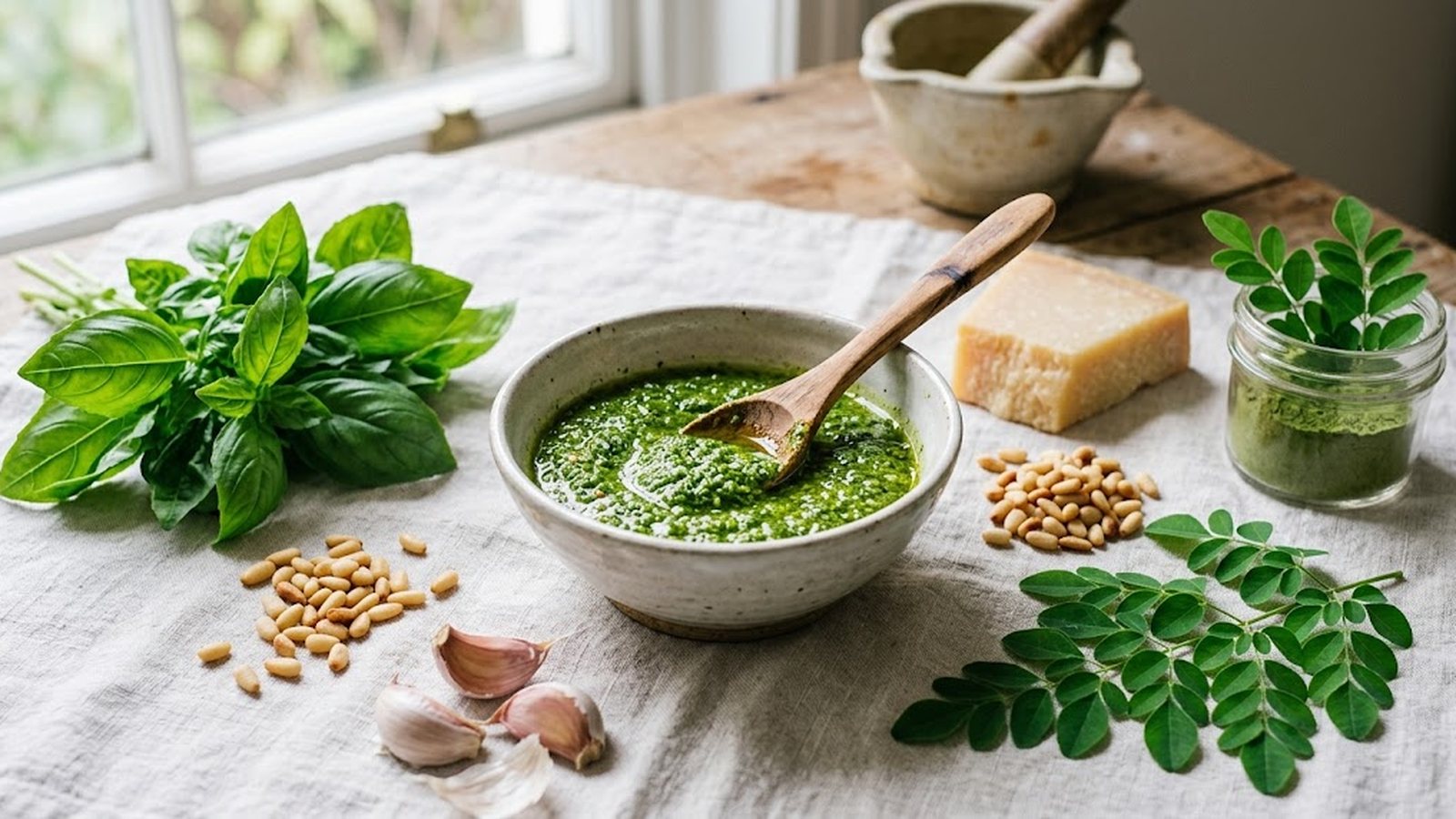
Moringa pesto is the recipe that converts people who thought they did not like moringa. A sauce is the ideal place for it: there is oil to carry the flavor, garlic and salt and acid to frame it, and other greens to share the work. A full teaspoon of powder, or a big handful of fresh leaf, disappears into a batch of pesto that tastes like pesto. I grow moringa on my small nursery plot in Hernando County, Florida, and through the summer the kitchen runs on these five sauces, because they use leaf faster than anything else I make. Every recipe below gives amounts for both fresh leaflets and dried powder.
Fresh leaf or powder?
Both work, differently. Fresh moringa leaflets blend like a tender herb, somewhere between spinach and watercress, with a mild peppery finish. They make a brighter, greener sauce. Moringa powder is the concentrated version: one teaspoon of powder is roughly a small handful of fresh leaflets in flavor and far more in nutrition by volume. It gives a deeper, earthier note and a darker color. If you are using powder, make the sauce, taste, and let it sit ten minutes before adjusting; the powder takes a few minutes to hydrate and the flavor settles.
Whichever you use, the sauce should taste like the sauce, not like moringa. The leaf is a supporting player. When it starts to dominate, you have added too much. For amounts across other dishes, see the moringa ratio chart.
1. Moringa pesto
This is a classic basil pesto with moringa doing part of the green work. All basil and moringa with no other softening is possible, but a bit sharp; the ratio below is the one I keep coming back to.
- 2 cups packed fresh basil leaves
- 1/2 cup packed fresh moringa leaflets, or 1 heaping teaspoon moringa powder
- 1/3 cup pine nuts, walnuts, or pumpkin seeds, toasted
- 2 cloves garlic
- 1/2 cup grated parmesan (or 3 tablespoons nutritional yeast for a dairy-free version)
- 1/2 cup good olive oil, plus more to loosen
- Juice of half a lemon
- 1/2 teaspoon salt, and black pepper
Toast the nuts in a dry pan until fragrant and let them cool. Pulse the nuts and garlic in a food processor until coarse. Add the basil, moringa, cheese, lemon, and salt, and pulse until chopped. With the motor running, drizzle in the oil until it comes together. Stop while there is still some texture. Taste. It wants salt more often than it wants anything else.
Keeps in the fridge for four or five days with a film of oil on top, and freezes well in ice-cube trays. Toss with pasta, spread on toast under a fried egg, thin with more oil and lemon for a salad dressing, or drop a spoonful into soup at the table.
2. Moringa chimichurri
The Argentine steak sauce, which is really just herbs, garlic, vinegar, and oil, takes moringa easily because it is already assertive.
- 1 cup packed fresh parsley
- 1/2 cup packed fresh cilantro (or more parsley)
- 1/4 cup fresh moringa leaflets, or 1 teaspoon moringa powder
- 3 cloves garlic, minced
- 1 small shallot, minced
- 1 teaspoon dried oregano
- 1/2 teaspoon red pepper flakes
- 3 tablespoons red wine vinegar
- 1/2 cup olive oil
- 3/4 teaspoon salt
Chop the herbs and moringa leaflets fine by hand; chimichurri is a chopped sauce, not a puree, and a food processor turns it to paste. Stir everything together and let it sit for thirty minutes before using. Spoon over grilled anything, roasted vegetables, or a plate of beans. Keeps a week in the fridge.
3. Green tahini
A Middle Eastern standby that happens to be the best-tasting home for moringa powder I know, because tahini's nuttiness and lemon's acid wrap around the green flavor completely.
- 1/2 cup tahini
- Juice of 1 lemon
- 1 clove garlic, grated
- 1/2 cup packed fresh parsley or cilantro, or a mix
- 1 heaping teaspoon moringa powder (fresh leaflets work too, about 1/3 cup)
- 1/2 teaspoon salt, 1/2 teaspoon ground cumin
- 1/3 to 1/2 cup cold water
Blend everything except the water until smooth, then add water a tablespoon at a time until it is the consistency of thick cream. It will seize up and look wrong halfway through; keep adding water and it comes back. Drizzle over roasted cauliflower, falafel, grain bowls, or use it as a dip for raw vegetables. It thickens in the fridge; loosen with water.
4. Yogurt herb sauce
The cooling one. Good with anything spicy or grilled, and a reliable way to get moringa into children, who will eat almost anything with a dip.
- 1 cup plain whole-milk yogurt or Greek yogurt
- 1/4 cup finely chopped fresh mint, dill, or cilantro
- 1/2 teaspoon moringa powder, or 2 tablespoons very finely chopped fresh leaflets
- 1 small clove garlic, grated
- Juice of half a lemon
- 1/4 teaspoon salt
- Half a cucumber, grated and squeezed dry, if you want it as a tzatziki
Stir together and rest for fifteen minutes. The moringa amount is deliberately small here because there is no oil or strong flavor to balance it; half a teaspoon gives a pale green sauce with a faint fresh note. Keeps three days.
5. Everyday moringa vinaigrette
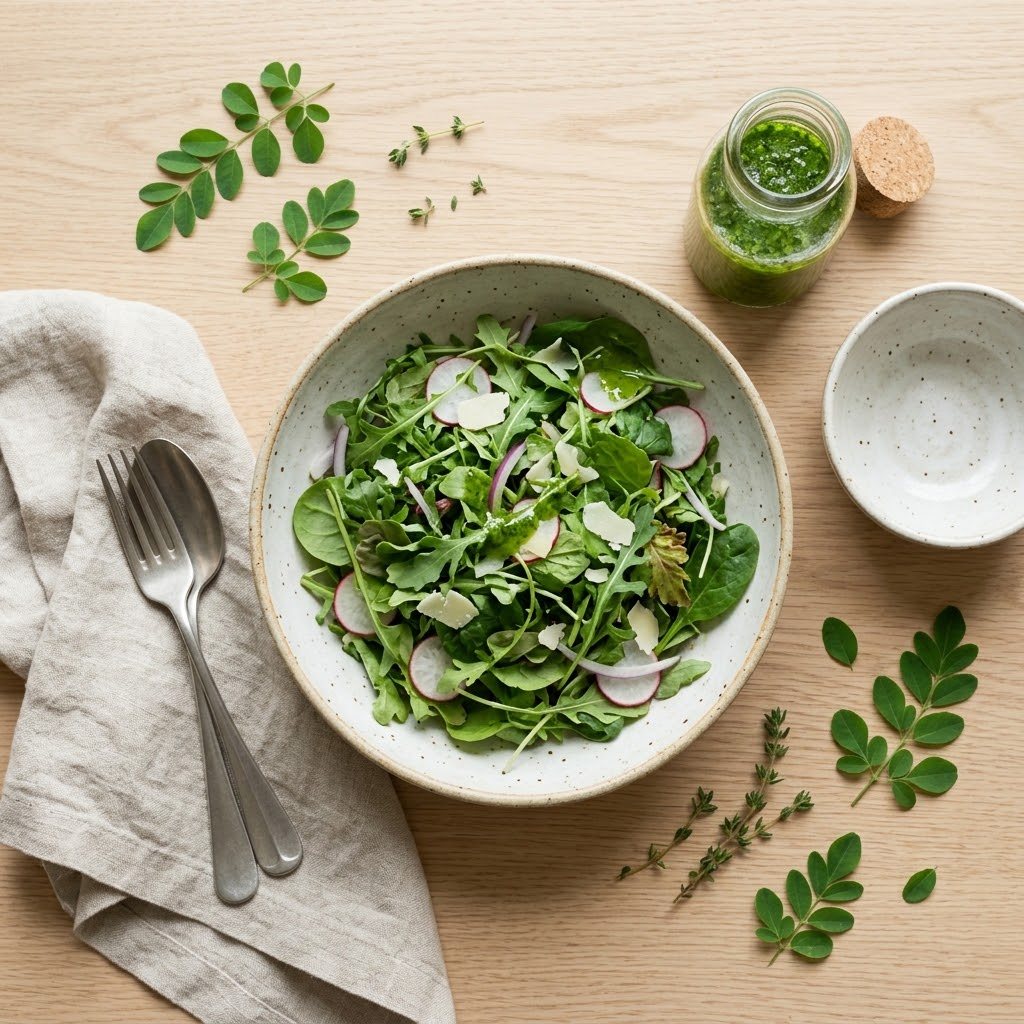
This one lives in a jar in my fridge door all summer. Shaking a vinaigrette in a jar is also the best way to disperse moringa powder into anything thin.
- 1/2 cup olive oil
- 3 tablespoons apple cider vinegar or lemon juice
- 1 teaspoon Dijon mustard
- 1 teaspoon honey or maple syrup
- 1 teaspoon moringa powder
- 1 small clove garlic, grated, or a teaspoon of minced shallot
- 1/2 teaspoon salt, black pepper
Put everything in a jar, lid on, shake hard for twenty seconds. The mustard emulsifies it and the powder stays suspended for a good while. Shake again before each use. On salads obviously, but also spooned over roasted potatoes or a bowl of warm lentils, where the moringa reads as a pleasant grassy depth. Keeps two weeks.
Getting the most from fresh leaf
If you have a tree, the sauces above are the reason to keep it pruned: a leafy hedge cut every couple of weeks gives you a steady supply of tender leaflets, and the tender ones are what you want in a raw sauce. Strip leaflets from the stems, rinse, and spin dry. Older, tougher leaflets are better cooked, and there is a whole guide to cooking with fresh moringa. Anything the kitchen cannot use in a few days becomes powder for the off season.
FAQ
Can you make pesto with moringa leaves?
Yes. Fresh moringa leaflets blend like a tender herb. Use them for about a quarter of the greens, with basil or another soft herb for the rest, and the pesto tastes like pesto with a mild green depth.
How much moringa powder should I put in pesto?
One heaping teaspoon per batch of about two cups of basil. More than that starts to take over the flavor. Let the pesto sit ten minutes after blending so the powder hydrates before you adjust.
Does moringa pesto taste different from regular pesto?
Slightly greener and earthier, with a faint peppery finish. At the amounts above most people cannot pick it out. Fresh leaf gives a brighter flavor than powder.
How long does moringa pesto keep?
Four to five days in the fridge with a thin layer of olive oil pressed over the surface, and several months frozen in ice-cube trays.
Can I use dried moringa leaves instead of powder?
Crumbled dried leaf works in the cooked or rested sauces, the vinaigrette and the chimichurri especially, but it stays slightly gritty in a smooth sauce like pesto or tahini. Grinding it to powder first is better.
The short version
Moringa belongs in sauces, where oil, acid, garlic, and salt do the work of making it taste like food. Fresh leaflets blend like a tender herb; a teaspoon of powder stands in for a handful of them. A basil pesto with a quarter of the greens swapped for moringa, a chimichurri, a green tahini, a yogurt herb sauce, and a shaken vinaigrette will use a full teaspoon a day without anyone noticing, which is the whole point.