Moringa Oil vs Argan Oil: Better for Face, Hair, or Shelf Life?
Moringa oil and argan oil compared honestly: origin, fatty acids, texture and absorption, use on face and hair, shelf life, price, and how to spot a diluted oil.
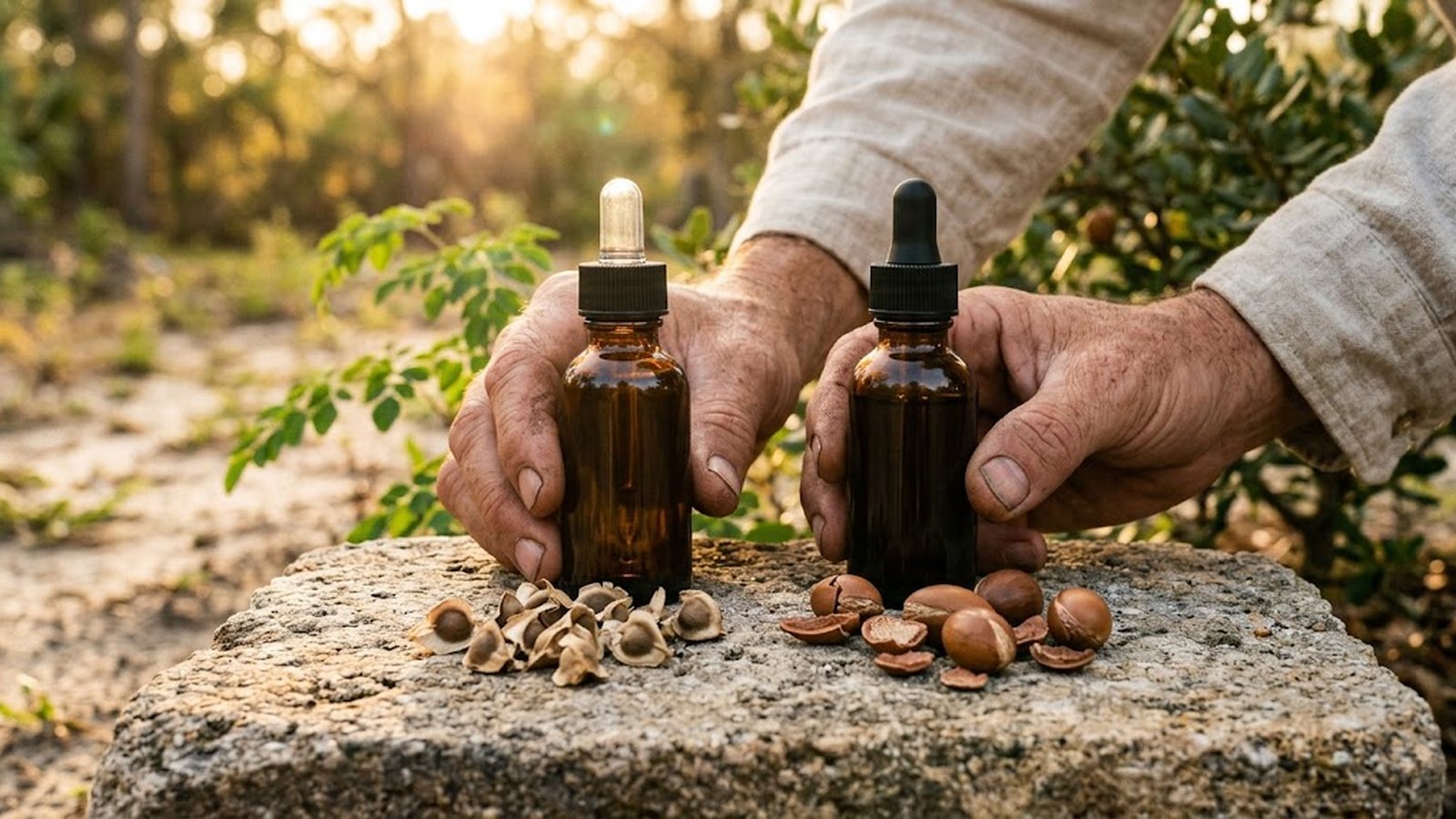
Moringa oil vs argan oil comes up constantly, because the two sit next to each other on the shelf and get sold with the same vocabulary. They are both plant oils pressed from seeds, both used on skin and hair, and both worth having. They are not the same, and the differences are practical: how each one feels, how fast it absorbs, how long it keeps, and what it costs. I sell cold-pressed moringa oil, sourced from a press partner I have vetted and checked by hand at the nursery in Weeki Wachee, so read this knowing which side I am on. I have tried to be fair to argan anyway, because I use it too.
Where each one comes from
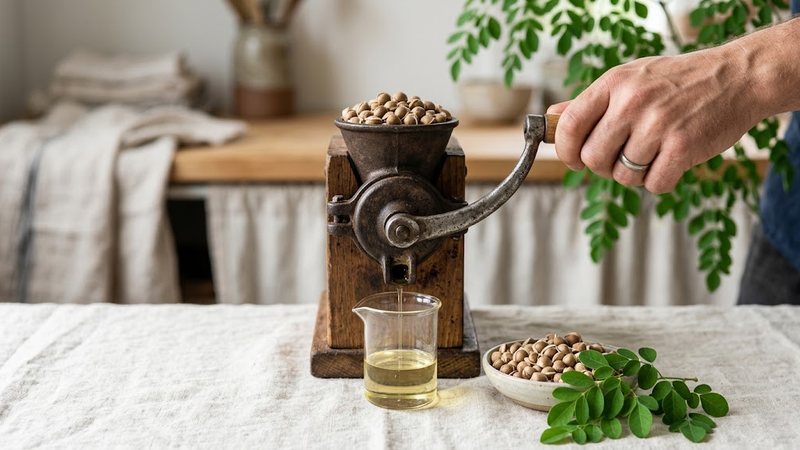
Moringa oil is pressed from the seeds of Moringa oleifera, the same tree that produces the leaf powder. The seed kernels are nearly 40 percent oil. It has been used for thousands of years, and the old name for it is ben oil, from the behenic acid it contains; it was prized by watchmakers and perfumers because it does not go rancid. Today most of it is pressed in India, Africa, and Southeast Asia. The story of how it is made is in the cold-pressed moringa oil guide.
Argan oil is pressed from the kernels of the argan tree, Argania spinosa, which grows almost nowhere on earth except southwestern Morocco. The fruit is harvested, the nuts cracked by hand, traditionally by women's cooperatives, and the kernels pressed. That limited range and labor-heavy process are why real argan oil is expensive and why so much of what is sold as argan oil is diluted.
What is in each oil
The single most useful way to compare oils is by their fatty acids, because that predicts feel, absorption, and shelf life.
| Moringa oil | Argan oil | |
|---|---|---|
| Oleic acid (monounsaturated) | Roughly 70 percent | Roughly 45 percent |
| Linoleic acid (polyunsaturated) | Very low, under 2 percent | Roughly 30 to 35 percent |
| Behenic acid (saturated, long-chain) | About 5 to 7 percent | Trace |
| Palmitic and stearic (saturated) | Around 10 percent | Around 18 percent |
| Vitamin E (tocopherols) | Present | Present, generally higher |
| Feel on skin | Light, silky, sinks in | Slightly richer, satiny |
| Oxidation resistance | Very high | Moderate |
The numbers vary by source and season, so treat them as ranges. The pattern is clear anyway. Moringa is a high-oleic, very-low-polyunsaturate oil. Argan is a balanced oil with a lot of linoleic acid. That one difference drives most of what follows.
On the face
Both oils are used as facial oils, alone or as the last step over a moisturizer. The experience differs.
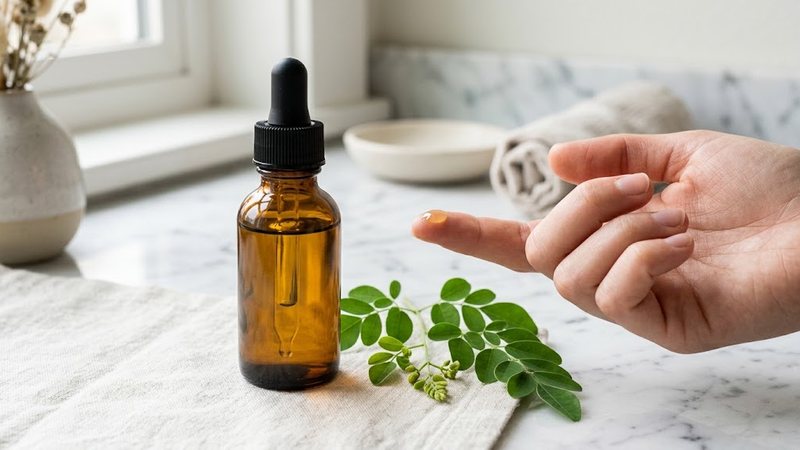
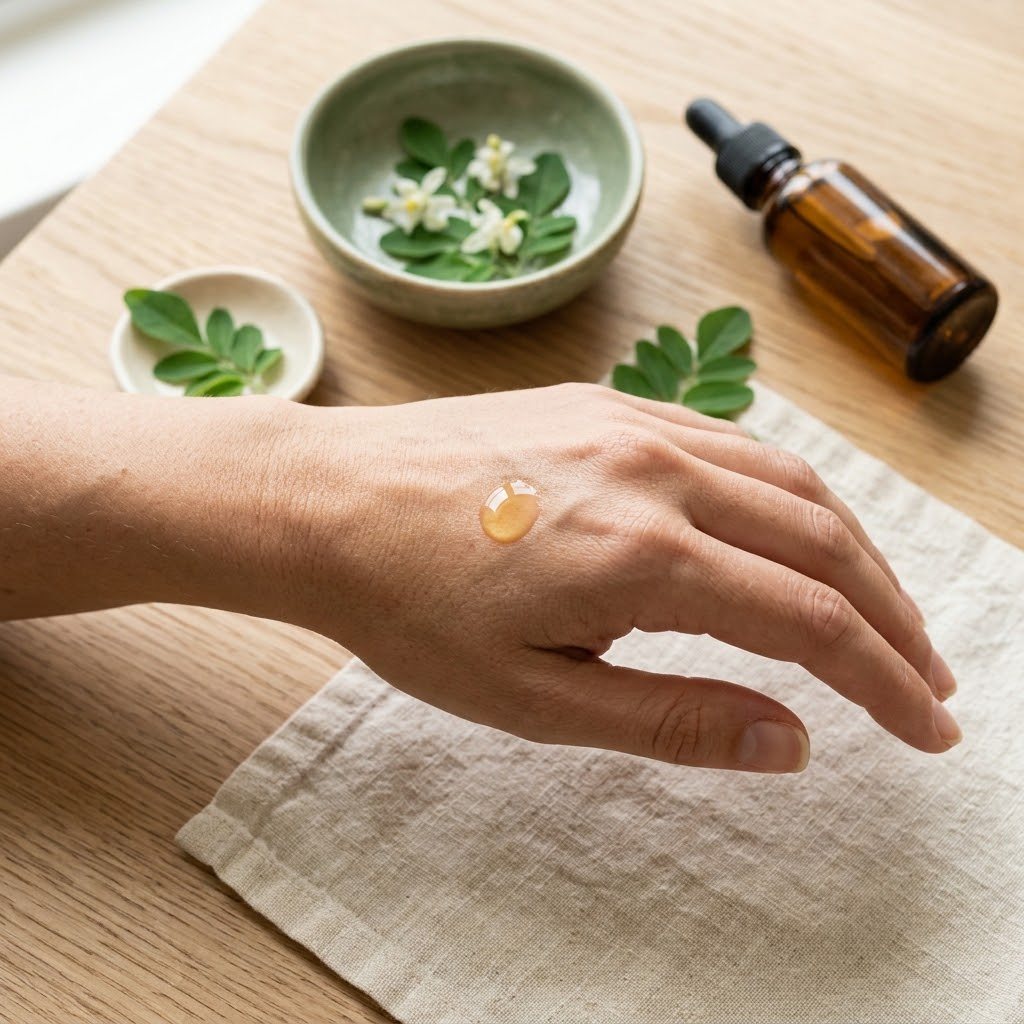
Moringa oil is light and absorbs quickly. A drop or two pressed onto damp skin disappears within a minute and leaves a soft, non-greasy finish. Its high oleic content and near-absence of linoleic acid make it feel closer to the skin's own sebum, which is why it suits dry, mature, and normal skin, and why some people with oily skin find it a touch too rich. It has almost no scent when fresh. The routine-by-skin-type detail is in the moringa oil face routine.
Argan oil feels slightly heavier going on and slightly lighter once absorbed, because the linoleic acid gives it a thinner, drier finish. It has a faint nutty smell, stronger in unrefined oil. Many people with combination or oily skin prefer argan for that reason. On dry skin, the two are close, and a lot of people alternate.
Neither treats or prevents any skin condition, and any seller who tells you otherwise is guessing. They are emollients: they soften the skin's surface and slow water loss. That is what a good oil does, and it is enough.
On hair
Argan oil built its reputation on hair, and it earns it. A few drops rubbed between the palms and smoothed over the lengths tames frizz and adds shine without much weight, and its faster-drying finish means it does not look greasy on fine hair. It is the better choice for a daily finishing oil on medium to fine hair.
Moringa oil is heavier on the hair, which cuts both ways. As a daily finishing oil it can weigh fine hair down, but as a pre-wash treatment, a scalp massage oil, or a leave-in for thick, curly, or coarse hair it works well, and it does not go rancid on the scalp the way polyunsaturated oils can. The methods are in moringa oil for skin and hair.
Shelf life: where moringa wins outright
Oils go bad by oxidizing, and the fatty acids most prone to it are the polyunsaturated ones. Argan is a third linoleic acid; moringa has almost none. The result is a real difference in how long each keeps.
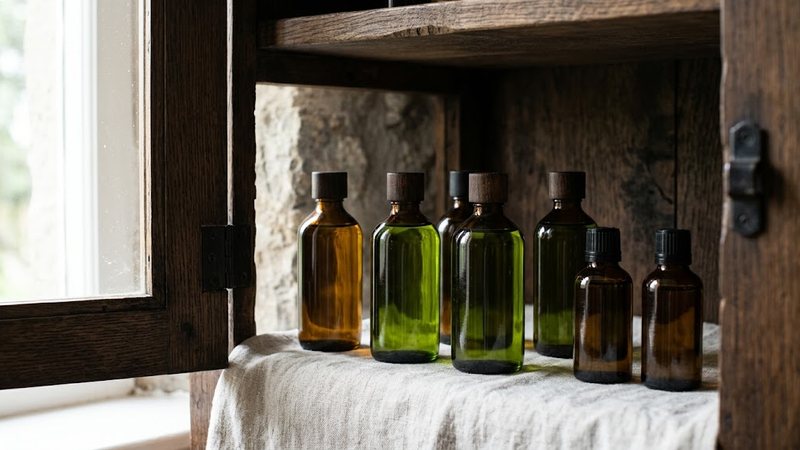
- Moringa oil stays fresh for two years or more in amber glass out of the heat, and well-stored oil goes much longer; its stability is the reason it was used to lubricate watches. Rancid moringa oil is rare, and when it happens it is usually a storage failure. Details in how long moringa oil lasts.
- Argan oil is good for about a year, sometimes eighteen months, before the nutty smell turns sharp and crayon-like. It should be bought in small bottles and used up.
If you buy oils and forget about them, moringa is the one that forgives you.
Price, and the fake problem
Real cold-pressed argan oil costs more than moringa, because the argan tree grows only in one corner of Morocco and the nuts are cracked by hand. That price has produced a market full of "argan oil" that is mostly a cheap carrier oil with a splash of argan for the label. Real argan smells faintly nutty, is pale gold, and is never cheap.
Moringa oil has the same problem on a smaller scale. Watch for oil that is water-clear and odorless in a way that suggests refining, oil sold in clear plastic, and oil that is suspiciously cheap for the size. Real cold-pressed moringa oil is pale gold, nearly scentless with a faint nutty, green note when you rub it warm, and it comes in amber glass from anyone who cares about it. The cold-pressed guide has the full list of tells.
Which should you buy?
- Dry, mature, or normal skin, want a light face oil that sinks in: moringa.
- Oily or combination skin, want a drier finish: argan.
- Fine to medium hair, daily finishing oil: argan.
- Thick, curly, or coarse hair, pre-wash and scalp treatments: moringa.
- You want one bottle that lasts years: moringa.
- You like a faint nutty scent: argan. Moringa is nearly scentless.
- Budget: moringa is usually the better value per ounce, and a one-ounce dropper of either lasts months on a face.
The honest answer for a lot of people is one small bottle of each: argan on the hair, moringa on the face and hands. They are not competitors so much as neighbors.
FAQ
Is moringa oil better than argan oil?
For shelf life, absorption on dry skin, and value, moringa has the edge. For a light daily hair oil and for oily skin, argan does. They are different oils with different strengths, not a better and a worse.
Can I use moringa oil instead of argan oil on my hair?
Yes, especially for thick, curly, or coarse hair, and for pre-wash or scalp use. On fine hair, moringa can feel heavier than argan as a daily finishing oil; use a single drop or keep argan for that job.
Which lasts longer, moringa oil or argan oil?
Moringa, by a wide margin. Its very low polyunsaturated content means it resists oxidation for two years or more in amber glass. Argan is best used within a year.
Does moringa oil smell like argan oil?
No. Fresh moringa oil is nearly odorless with a faint nutty, green note when warmed. Argan has a noticeable nutty scent, stronger in unrefined oil.
Can you mix moringa oil and argan oil?
Yes. Equal parts gives an oil lighter than moringa and more stable than argan, and it is a reasonable all-purpose face and hair blend. Mix small amounts so the argan does not age the batch.
The short version
Moringa oil is a light, nearly scentless, high-oleic oil that sinks into dry and mature skin fast, suits thick hair and scalp treatments, and keeps for years. Argan oil is a balanced, faintly nutty oil with a drier finish that suits oily skin and fine hair as a daily finisher, and it should be used within a year. Moringa is the better value and the better keeper; argan is the better hair shine. Buy real cold-pressed versions of either in amber glass, and consider owning both.