Moringa Pests and Problems: A Florida Grower's Field Guide
The pests that bother moringa in Florida and the South (aphids, caterpillars, whiteflies, mites, grasshoppers, termites, root rot) and the low-effort organic fixes.
Moringa pests are a shorter list than most garden plants get, which is one of the reasons the tree is such a pleasure to grow. It has few serious diseases, it outgrows most damage, and a healthy tree in full sun with sharp drainage shrugs off nearly everything. But "few" is not "none," and Florida in particular has a couple of leaf-eaters that can strip a young tree in a week. This is the list of what I actually see here in Weeki Wachee, on Florida's Gulf coast, what each one looks like, and what I do about it. I grow for eating, so every fix here is something I am comfortable using on leaf I will pick tomorrow.
The most important pest is water
Before the bugs: the thing that kills more moringa than every insect combined is wet feet. Root rot from poor drainage, overwatering, or a low spot that floods in summer storms takes out more trees than aphids ever will. If a tree is declining and you cannot find a pest, check the soil. The full pattern is in why moringa leaves turn yellow. Get drainage right and the pest list below becomes an occasional nuisance rather than a battle.
Caterpillars
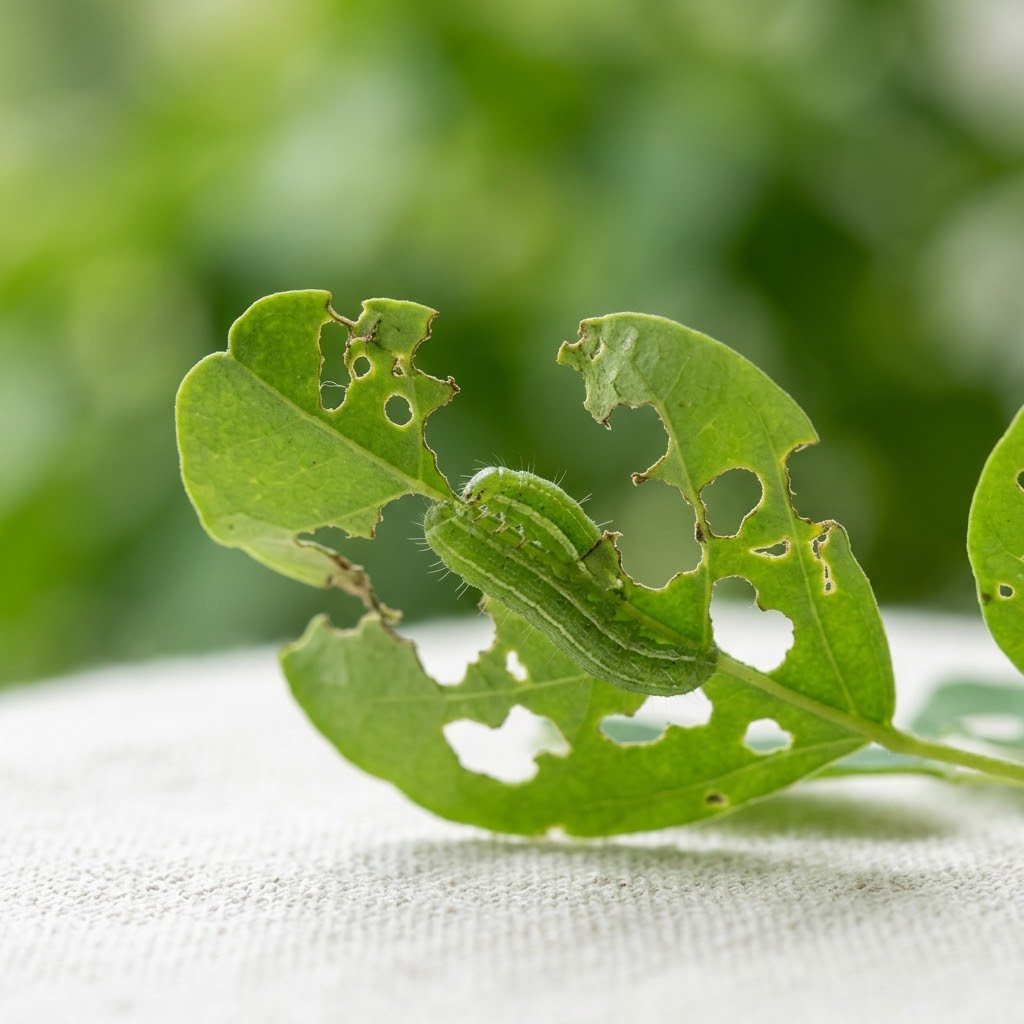
What you see: Leaflets with ragged holes or eaten to the midrib, dark droppings on the leaves below, and if you look on the undersides of leaves in the morning, green or striped caterpillars an inch or two long. In Florida the usual culprits are various moth larvae, and they arrive in waves, often in late summer.
Why it matters: A big tree can lose a third of its leaf and not care. A seedling can be stripped bare overnight.
What I do: Hand-pick in the morning and feed them to the chickens. For a bad wave on young trees, Bt (Bacillus thuringiensis), a bacterial spray that affects only caterpillars, sprayed on the leaf in the evening. It is approved for organic growing and safe for bees, and I can pick leaf a day later after a rinse. Check trees every few days in August and September; catching the first few caterpillars beats treating a hundred.
Aphids
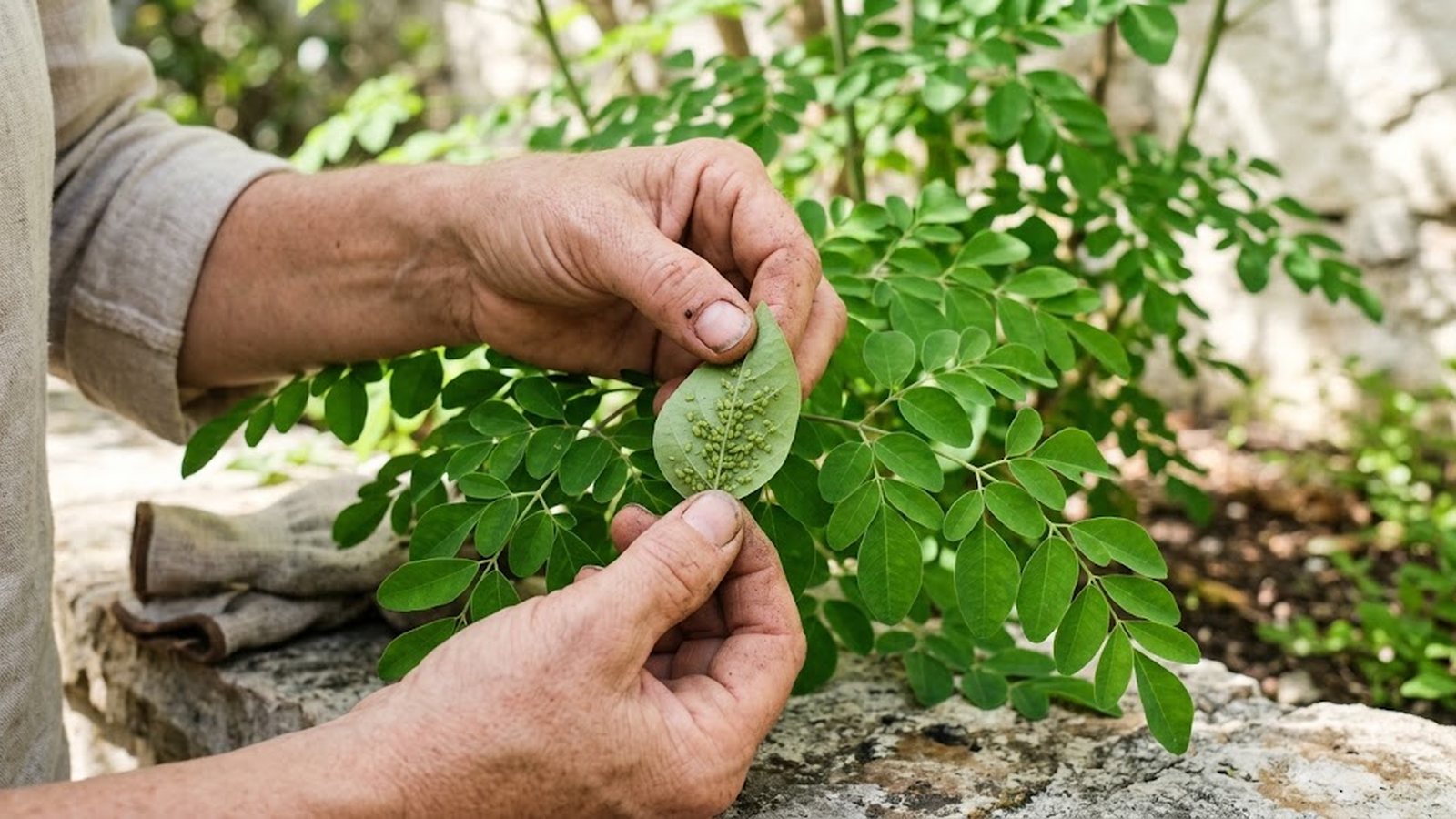
What you see: Clusters of tiny soft insects, green, black, or grey, packed on the newest shoots and the undersides of young leaves. New growth curls and puckers. A sticky shine on leaves below, sometimes followed by black sooty mold growing on the stickiness. Ants running up and down the trunk, farming them.
What I do: A hard jet of water from the hose, aimed at the undersides, knocks most colonies off and they do not climb back. Repeat every couple of days for a week. If that is not enough, insecticidal soap or a light neem oil spray in the evening, never in midday sun on this plant, which scorches. Ladybugs and lacewings show up on their own within a week or two of an aphid outbreak here and finish the job if you do not spray anything that kills them too. A tree that gets aphids every spring is usually a tree that is being over-fertilized; soft, nitrogen-pushed growth is what they want.
Whiteflies
What you see: Tiny white moth-like insects that fly up in a cloud when you brush the leaves. Undersides dotted with small pale scales. Leaves yellow and get sticky. Common on potted trees and trees near vegetable gardens.
What I do: Yellow sticky cards hung in the branches catch a surprising number. Water blasts and insecticidal soap on the undersides for the rest. They are more annoying than dangerous on a tree in the ground, and a good pruning that opens up the canopy reduces them a lot.
Spider mites
What you see: Fine yellow stippling across the leaf, a dusty or bronzed look, and in bad cases fine webbing at the leaf joints. Tap a leaf over white paper and tiny moving specks fall out. Mites show up in hot, dry spells, especially on potted trees against a warm wall or trees under a roof overhang where rain never reaches them.
What I do: Water. Mites hate humidity and a regular hosing of the undersides breaks the cycle. For a heavy infestation, insecticidal soap or neem in the evening, repeated twice a week for two weeks to catch the hatching eggs. Moving a potted tree out of the hot corner solves it permanently.
Grasshoppers and katydids
What you see: Big irregular chunks missing from leaves, and the insect itself, which is not hiding. The eastern lubber grasshopper, that huge black-and-yellow thing, is common here and will work through a small tree in a day.
What I do: Catch and remove. Lubbers are slow. A pair of gloves and a bucket of soapy water in the morning is the whole program. Sprays are pointless against something that size.
Termites and borers on young trees
What you see: A seedling or first-year tree that wilts and snaps off at ground level, with tunnels in the stem or a hollow trunk. More common in newly cleared ground and in beds with a lot of woody debris.
What I do: Keep mulch a couple of inches back from the trunk of a young tree so the stem is not buried in damp wood, and do not plant directly into a spot where an old stump was ground out. Once a tree has a thick trunk this stops being a problem.
Leaf-miners
What you see: Pale, winding trails inside the leaflet where a tiny larva has tunneled between the leaf surfaces.
What I do: Nothing, usually. Pick the affected leaflets if it bothers you. It is cosmetic on moringa and the tree outgrows it.
Diseases
Moringa has very few. Root and collar rot from wet soil is the one that matters and it is covered above. Occasionally in a long wet spell you will see dark spots or a grey fuzz on leaves; pick those leaves, improve air flow by pruning, and it clears when the weather dries. Powdery mildew shows up rarely in shady, humid spots and the answer is the same: more sun, more air. I have never sprayed a fungicide on a moringa and do not expect to.
Prevention beats every cure on this list
- Full sun and sharp drainage. A stressed tree gets pests. An unstressed tree mostly does not.
- Do not over-feed. Soft, fast, nitrogen-pushed growth is what aphids and whiteflies look for.
- Prune for airflow. An open, hedge-shaped tree dries fast after rain and gives pests fewer hiding places. See how to prune moringa.
- Look under the leaves once a week. Most of the above is trivial at ten insects and a chore at ten thousand.
- Let the predators work. Ladybugs, lacewings, wasps, lizards, and birds do most of my pest control. Broad-spectrum sprays kill them along with the pests and leave you doing the job alone next time.
- Keep a few seeds in reserve. A moringa tree is cheap and fast. If a seedling is lost to lubbers, the replacement is a season away, not a decade.
What I will and will not spray on leaf I eat
Water, insecticidal soap, neem oil, and Bt. That is the entire list. All are approved for organic production, all break down fast, and all wash off. I do not use systemic insecticides on a plant I harvest every week, and I would not buy leaf powder from anyone who does. It is one of the questions worth asking a seller, alongside drying temperature, and the buying guide covers the rest of that conversation.
FAQ
What is eating my moringa leaves?
Ragged holes and droppings mean caterpillars. Big chunks missing means grasshoppers or katydids. Curled, sticky new growth means aphids. Tiny white insects that fly up when disturbed are whiteflies. Look under the leaves in the morning and you will usually find the culprit.
Can I spray neem oil on moringa?
Yes, diluted per the label, in the evening or on an overcast day. Neem applied in full midday sun can scorch moringa leaves. Rinse leaf before eating and wait a day or two after spraying.
Do moringa trees get diseases?
Very few. Root rot from wet soil is the only common one. Leaf spots and mildew appear occasionally in humid shade and clear up with more sun and better airflow.
Why does my moringa have ants on it?
Ants farm aphids for their sticky honeydew. If you see ants running the trunk, look for aphids on the new growth. Deal with the aphids and the ants leave on their own.
Are moringa pests dangerous to the tree?
Rarely, for an established tree. Moringa outgrows most damage within weeks. Seedlings and first-year trees are the exception and are worth checking every few days in late summer.
The short version
Drainage first, because wet soil kills more moringa than any insect. After that: caterpillars (hand-pick or Bt), aphids (water jet, soap, or wait for the ladybugs), whiteflies (sticky cards and soap), spider mites (humidity and soap), grasshoppers (gloves and a bucket), and termites on seedlings (keep mulch off the stem). Full sun, moderate feeding, an open pruned shape, and a weekly look under the leaves prevent nearly all of it. Water, soap, neem, and Bt are the only things I put on leaf I am going to eat.